Protecting a high-end Parisian apartment and its valuable furnishings is a legitimate concern for any owner, especially when it comes to their primary residence. The desire to install cameras, video intercoms, and smart alarms is understandable, and you are free to do so when you are living there yourself.
However, in the context of short-term rentals in 2026, the line between protecting your property and respecting your guests’ right to privacy is strictly regulated. Between the tightening of rules by Airbnb and major rental platforms, as well as the requirements of the CNIL (National Commission on Informatics and Liberty, in French) and the GDPR (in French), a single mistake could lead to the removal of your listing or even criminal penalties.
At GLAMAPARIS, trust is our top priority. Here is our guide to securing your property in full compliance with regulations.
A – The case of the owner’s primary residence
Indoor cameras: a complete and permanent ban
Let’s start with the strictest rule, which is now standard on most premium booking platforms:
- Zero tolerance: As of April 30, 2024, the presence of any security camera inside a listing is strictly prohibited, even if it is turned off, unplugged, or mentioned in the listing.
- Penalties: The presence of an indoor camera (in the living room, hallway, or facing the front door from the inside) will result in the immediate and permanent suspension of your account, as well as a full refund for guests. Physically remove any video devices from inside your apartment. Even a dummy camera can lead to an irreparable dispute.
Video doorbells (Ring, Nest, etc.): be aware of the Parisian context
Outdoor cameras and smart doorbells (video doorbells) remain permitted, but are subject to strict legal oversight. In Paris, the layout of apartment buildings often makes their installation complicated.
- Transparency: Their presence must be clearly and explicitly mentioned in your listing before any reservation is made.
- Respect for neighbors (CNIL): According to CNIL regulations on home video surveillance (in French), a camera must only film the interior of your property. If your video doorbell captures the common landing, the staircase, or a neighbor’s door, you are in violation (invasion of privacy).
- Solution: If you install a video doorbell, digitally restrict the field of view (by masking certain areas) so that it only activates when someone crosses your threshold.
The pitfall of alarm kits with remote monitoring (such as Verisure and Homiris)
Installing a professional alarm system connected to a remote monitoring center seems like the ideal solution for peace of mind. However, these standard systems hide a major risk of non-compliance.
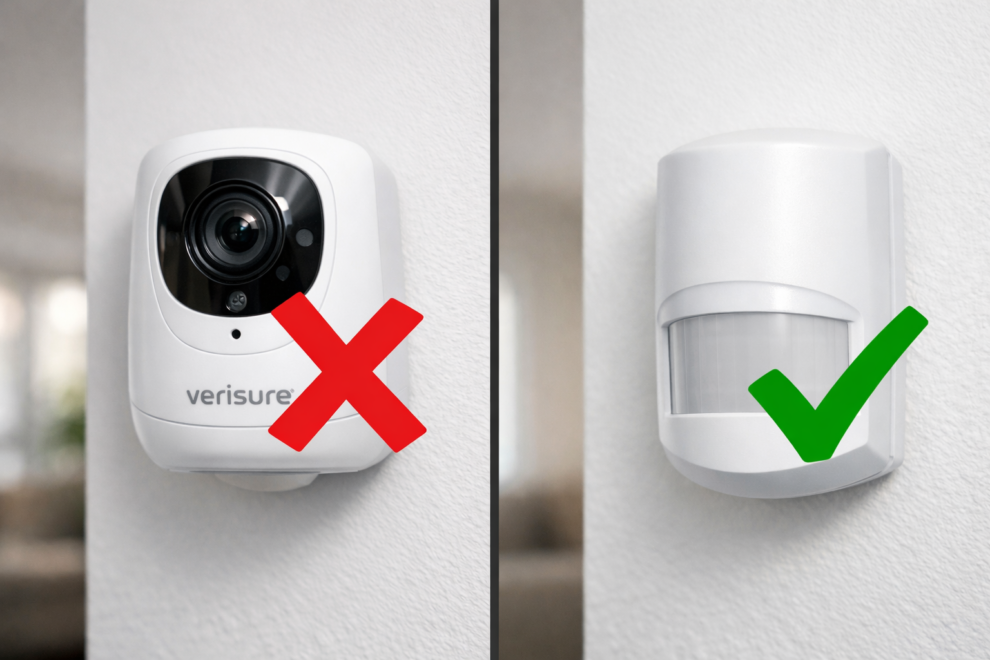
- The problem of visual “verification”: To avoid unnecessary dispatches, these companies almost always install motion detectors equipped with a camera or an integrated camera in living areas. If triggered, photos are taken automatically.
- Incompatibility: Major booking platforms make no distinctions. Even if the alarm is disabled during the stay, the mere presence of a sensor with a lens constitutes a strict violation. A traveler who notices the lens and reports it with a photo can lead to the suspension of your account.
Solutions for legally compliant security:
Insist on “blind sensors”: Ask your supplier to replace all photo/video sensors with simple infrared motion detectors (without lenses).
- Use opening sensors: Shock and opening sensors placed on doors and windows are 100% compliant (they capture neither images nor sound).
- Manage access: Your guests must be able to easily disable the alarm upon arrival to avoid false alarms and conflicts with the other residents.
GDPR: Your obligations as a property owner
If you use lawful surveillance devices (such as a properly configured video doorbell), you are subject to the General Data Protection Regulation (GDPR, in French).
- Clear notification: A physical sign must inform visitors of the presence of an external surveillance system.
- Data retention: The CNIL imposes a limited retention period (in French), generally a maximum of 30 days for images recorded by private individuals.
In summary: The security of your Parisian pied-à-terre should never come at the expense of your guests’ privacy. At GLAMAPARIS, we prioritize rigorous, human-driven screening of guests (profile verification, in-person check-in) to prevent incidents, often making intrusive technological surveillance unnecessary.
Key takeaway: If you have a security system in your apartment, adapt it for rentals to comply with current regulations. Be sure to remove all cameras or video devices from the interior before each rental. This way, you can continue to use your system during your personal stays.
B – The case of a property used for purposes other than residential (commercial space) intended for use as a hotel or furnished vacation rental
In this case, the property is intended for rental. It must therefore comply with current regulations. Since no cameras are permitted, to protect your property against intruders, squatters, or home invasions, opt for shock and opening sensors installed on doors and windows, which are 100% compliant. Motion sensors are also permitted, provided they are not equipped with lenses.
Do you own an apartment for rent? Get in touch with us.
Since 2008, we have placed a special emphasis on ensuring the satisfaction of both landlords and tenants.
With our agency located in the Saint-Germain-des-Prés neighborhood, in the heart of Paris’s 6th arrondissement, we have chosen to manage apartments near our offices, close to the Jardin du Luxembourg, or in the 1st, 4th, 5th, or 7th arrondissements.